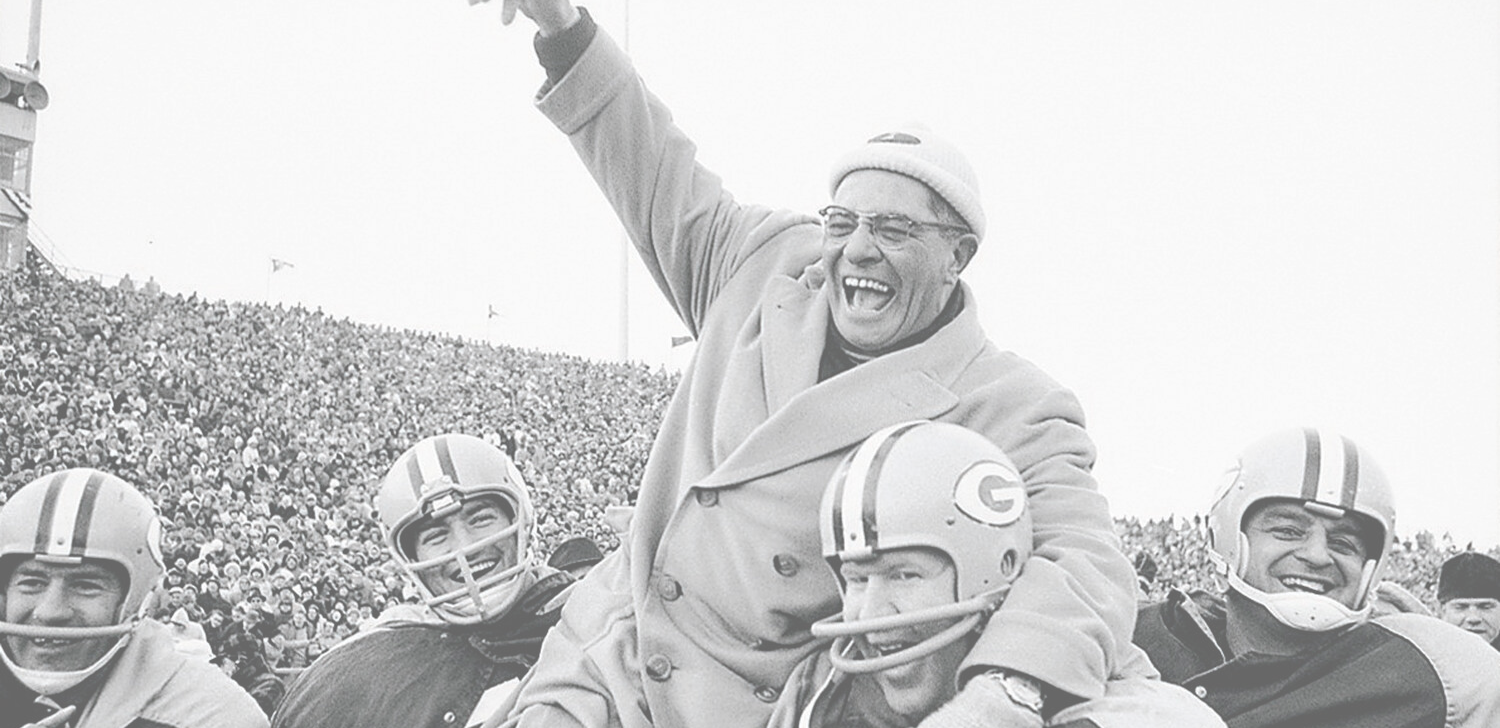
Vince Lombardi’s football coaching career began at Fordham University. After the 1948 season, he left his assistant coaching role at Fordham to begin an assistant coaching role at West Point. The two teams played each other in 1949 and there was a sense that both had something to prove. Fordham wanted to show that they could succeed without Lombardi; Lombardi wanted to prove that he had been deserving of more during his time at Fordham, and that his talents transcended any individual team.
The game turned out to be more fight than football. The sportswriter Tim Cohane wrote, “With a complete disregard for the sensibilities of the assemblage, including the Jesuits and the Army brass, the Cadets and the Rams went to work on each other with everything short of stilettos and strangling cords.” Herb Seidell, a captain at Fordham, said “I was told that seventeen teeth came out of nine different mouths. I lost one. I got my whole face pranged when I was blindsided coming off the field after a punt. That’s the kind of game it was.”
After the game the coaches had their feelings about who was at fault and how to better manage the emotions of their young athletes. Lombardi’s takeaway was broader. In When Pride Still Mattered David Maraniss writes:
But in the end, Lombardi took a lasting lesson from that game that had nothing to do with fighting. For the rest of his career, he would remember how Fordham reacted late in the second quarter when it was trailing 7 to 0. ‘Fordham panicked,’ Lombardi said years later. Twice in a row the Rams tried to score quickly with passes and were intercepted both times, leading to quick Army scores. Instead of trailing by seven points at halftime, they faced an insurmountable three-touchdown disadvantage. ‘I never forgot this,’ Lombardi said. From then on, whenever a quarterback pleaded for a last-minute touchdown strike before the half, Lombardi said no, remembering Fordham’s 1949 collapse at Michie Stadium.
Vince Lombardi would go on to coach the Green Bay Packers for nine years. During that time he won five championships, including three in a row, a feat that hasn’t been repeated since. His legacy lives among coaching and leadership legends.
The Wellington Fund is a mutual fund that launched in 1928 as history’s first “balanced fund.” It includes stocks – which tend to perform well when markets favor riskier investments – as well as bonds that – owing to their more conservative nature – offer limited upside potential, but serve to dampen risk of loss when riskier investments fall out of favor. The historic fund was named after the company that created it, Wellington Management Company.
In the mid-60’s John Bogle was a rising star inside of Wellington Management Company. By contrast, the Wellington Fund was enduring a period of slower growth. During the first half of the decade, the S&P 500 – a basket of approximately 500 stocks – swelled 87 percent, while the Wellington Fund was up a mere 5 percent. Investors took note. During this period, the once-popular Wellington Fund saw its share of investor cash flow plummet from 40 percent to 1 percent. Bogle felt the need to respond. Looking back, he said:
Perhaps overly confident, I thought the solution was obvious. Imagine you run a bagel shop and your customers are deserting you in droves, buying doughnuts from the shop across the street. To survive – or so I thought – you must start selling doughnuts yourself.
…
So that’s what we did.
Bogle hired a firm called “Thorndike, Doran, Paine & Lewis, Inc” who specialized in investing in higher-risk stocks, and allowed them to increase the stock holdings – and risk profile – of the Wellington Fund.
And then the market turned.
Between January 1973 and October 1974 the S&P 500 fell 48%. In The Bogle Effect Eric Balchunas writes:
Even worse, though – and ultimately heartbreaking for Bogle – was that the Wellington Fund went down the same amount as the stock market… That was a far cry from its relatively sturdy performance during the Wall Street Crash of 1929, in which it was buffered from the steep downside of the crash, declining only 3 percent in October 1929 versus 20 percent for the S&P 500.
This time, though, the “balanced” fund did not provide any balance. There was no buffer. It betrayed its objective and reputation. Had it stuck to its original objective – holding more bonds – it would have gone down much less than it did.
Shortly thereafter Bogle was fired from Wellington Management Company.
The experience would drive him to begin a new company, The Vanguard Group, the motto of which would be “Stay the Course.” He would reflect, “During Vanguard’s long history, that advice has worked magnificently.” Indeed, at the time of his passing in 2019 the company would manage approximately $5 trillion and claimed the honor of being the world’s largest mutual fund complex.
It is said that Napoleon defined a military genius as “The man who can do the average thing when all those around him are going crazy.”
Success, then, does not demand exceptional tactical decision-making in high-pressure situations. It does, however, require resistance to panic.
