Leonardo da Vinci’s devotion to scientific integrity was perhaps his most distinguishing quality as an artist, and it was an indispensable ingredient in the masterpieces he created.
Optics
Leonardo was entranced by the science of optics.
He noticed that the boundary lines that defined shapes in most paintings weren’t a visible quality in real figures characterized by three dimensions. He had to know why. So he conducted experiments and dissections to understand the mechanics of vision. He studied eyeballs, examined the insides of skulls (of humans and other species) and the nerves inside them that connected the eyeballs to the brain. He concluded:
The true outlines of opaque bodies are never seen with sharp precision … This happens because the visual faculty does not occur at a point; it is diffused throughout the pupil (rather, retina) of the eye.
Leonardo’s scientific breakthroughs related to optics wouldn’t be rediscovered for over a century. His findings fueled his belief that, like the forms seen in real life, forms seen in paintings should be defined by their shadowing.
Shadows
While most painters of the late 1400’s and early 1500’s relied chiefly upon these artificial boundary lines to give their subjects shape, Leonardo insisted this was misguided: “Shadow is the means by which bodies display their forms. The forms of bodies could not be understood in detail but for shadow.”
He studied and published on the topic emphatically. In his biography on Leonardo, Walter Isaacson writes:
Using his feel for proportional relations, he calculated the effects of light striking contoured objects at varying angles … He came up with multiple categories of shadows and plotted chapters on each: primary shadows that are caused by direct light hitting an object, derived shadows that result from ambient light diffused through the atmosphere, shadows that are subtly tinged with light reflected from nearby objects, compound shadows cast by multiple sources of light, shadows made by the subdued light at dawn or sunset, shadows made by light that has been filtered through linen or paper, and many other variations.
Today, 30 pages and over 15,000 words of his research on shadows is preserved, and biographers estimate he likely published more than twice this volume. His research took on a level of complexity and sophistication that was unprecedented, not just among artists, but among scientists, as well.
Perspective
During his time, the basics of perspective were no secret: one object twice as far away from a viewer as a second object will appear half as large. But again, Leonardo would greatly advance the scientific understanding of perspective with his appreciation for color and clarity. He argued that forms did not only become smaller with distance, but that their colors became less distinct, their shapes less sharp, and their details more difficult to depict.
How many, in the representation of towns and other objects remote from the eye, express every part of the buildings in the same manner as if they were very near … It is not so in nature, because it is not possible to perceive at any great distance the precise form of objects. The painter therefore who delineates the outlines and the tiny details of parts, as several have done, will not accurately depict distant objects, but this error will make them appear exceedingly near.
Leonardo would further show that air has matter; this substance increasingly interferes with one’s ability to perceive details as distance increases. He devised an experiment that proved the impact of distance on color: On a pane of glass through which two trees of different distances could be viewed – one twice as far away as the other – he traced their forms and color.
The eye can never arrive at a perfect knowledge of the interval between two objects by means of the linear perspective alone, if not assisted by the perspective of colors … Let the colors vanish in proportion as the objects diminish in size, according to the distance.
Western art, often characterized by landscapes, would be forever changed by Leonardo’s innovations exploring the impact of clarity and color on perspective.
The Last Supper
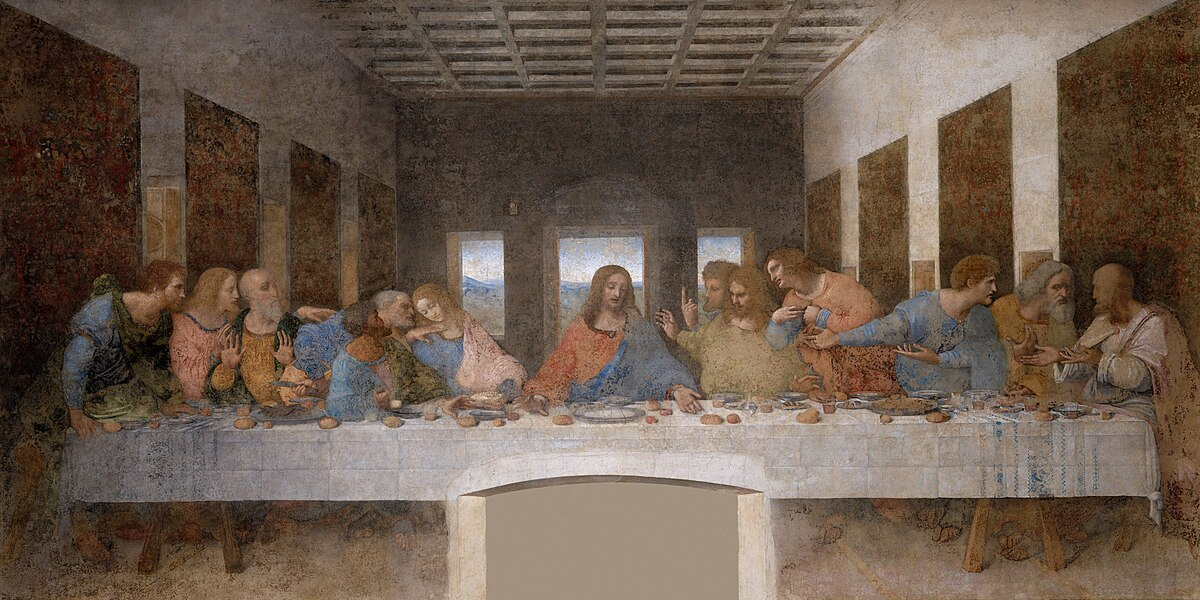
In 1494 Ludovico Sforza officially became the Duke of Milan and soon thereafter decided to create a mausoleum for himself and his family in a local church, Santa Maria delle Grazie. He commissioned Leonardo da Vinci to paint The Last Supper, a famous religious scene, on the north wall of the refectory. Leonardo began work in 1495.
Scientifically, the commission would prove challenging.
Through his studies, Leonardo had found that the correct distance from which to view an image was “at least twenty times as far off as the greatest height and width of your work.” The space afforded him to paint The Last Supper was nearly 30 feet wide and 15 feet high, placing the correct vantage point somewhere between 300 and 600 feet away. The room simply wasn’t large enough to accommodate a mathematically accurate vantage point.
Furthermore, the refectory had doors on both the west and east walls, so viewers would see the work from both extremes. When viewing an image on a phone or a 4×6 photograph, the left and right edges are close enough together that the viewer’s perspective is not materially impacted whether the image is centered in front of one’s eyes or set off to the side. By contrast, depending on where one stands, the left and right edges of The Last Supper can be equidistant from the viewer’s eyes, or a distance nearly 30 feet apart. Thus, the painting would appear different depending on where the viewer stood: “No surface can be seen exactly as it is, because the eye that sees it is not equally remote from all its edges.”
The constraints of the room rendered a scientifically accurate depiction of The Last Supper impossible – but you’d never know it.
To a 15th century churchgoer or a modern day tourist, everything appears correct; all the perspective lines rightfully converge at a central location and the shadowing produces depth and motion that seem to give this two dimensional moment life.
A closer look reveals how the rules of science had to be manipulated to make The Last Supper the masterpiece that it is.
Because the painting is elevated high off the ground, the natural vantage point should also be elevated high off the ground, impossible for any viewer. To overcome this, Leonardo crafted the painting in such a way that the focus of those entering the room from the right side would naturally gravitate to Jesus’ left hand, strategically set palm up, as if welcoming viewers into the dining hall. Moreover, the right ceiling of the scene is painted brighter, and set at a higher angle, amplifying the natural feel for those entering from the right side.
The tapestries in the painting continue the same perspective lines offered by the tapestries in the dining hall itself, distracting from the improper vantage point and making the dining hall in the painting feel like an organic extension of the dining hall of the church.
If the perspective lines on the floor could be seen, one would notice they’d been distorted. However, Leonardo masked these lines with the tablecloth, obscuring the scientific inaccurary. Similarly, following the perspective lines of the ceiling, one realizes that the ceiling itself wouldn’t extend above the table. But this artificially accelerated perspective is subtly hidden by a painted cornice above the table.
These clever techniques were implemented gently and strategically. They don’t draw attention to scientific inaccuracies; rather, they make it possible for viewers to appreciate the scientific and artistic beauty that would otherwise be incompatible in such a space.
Isaacson writes:
In The Last Supper, the painted room diminishes in size so quickly that the back wall is just large enough to have three windows showing the landscape outside. The tapestries are not proportional. The table is too narrow for a comfortable supper, and the apostles are all on one side of it, where there are not enough places for them to sit …
…
The tricks of perspective are accompanied by other clever contrivances, including little touches to make the scene appear as if it is connected to the monks eating in the refectory. The light in the painting appears to come from the actual window that is high on the left wall of the refectory, blending reality with imagination. Look at the right wall in the painting; it’s bathed in afternoon light as if from the actual window. Also notice the legs of the table: their shadows are cast as if from this source…
…
All told, The Last Supper is a mix of scientific perspective and theatrical license, of intellect and fantasy … his study of perspective science had not made him rigid or academic as a painter. Instead, it was complemented by cleverness and ingenuity…
Art and Science: Everywhere
Had Leonardo been unwilling to look beyond the laws of science, The Last Supper would merely have been a technical study. His creativity and willingness to bend those technical skills – to adapt the science to the canvas at hand – has allowed The Last Supper to reign as an undisputed masterpiece for 500 years.
Indeed, the synergy emerges when we’re able to appreciate when the laws of science should be inflexible, and when they should be adaptable; when to lean on science, and when to lean on art.
Even in disciplines like wealth management.
At a moment’s notice, one could easily find dozens of research papers proclaiming formulas for the optimal amount of cash on hand, or the surefire way in which employer equity compensation should be diversified. But here, too, an exclusively technical approach falls short. Different individuals feel safe with different levels of cash in the bank; while the risk of concentrated employer stock may feel unbearable for some, for others it offers a sense of fulfillment, community, and purpose that can’t be bought. Just as a painting’s quality will be dictated by the care with which it’s technical integrity is fitted to a specific room with specific dimensions and light, the ultimate quality of financial decisions will be dictated by how well numerical analysis is complimented by the human considerations that often lie beyond spreadsheets, tax returns, and financial planning software.
Indeed, the highest expression of wealth management emerges when the rigid rules of financial planning are softened around an individual’s unique circumstances, ambitions, and emotional disposition.
The Last Supper is an unparalleled – and much more beautiful – metaphor for the balance of art and science. That said, beauty is in the eye of the beholder, and wealth management has its own exquisite charm.